
Our framework -- the Norton Henry System -- which enables us to carry on legacies of owner-operated businesses rests on five legs: People, Customers, Products, Delivery, and Culture (see The Norton Henry System). Our financial model flows across each leg, and is the topic of this post. If you see value in our financial model for your business, please contact us to discuss implementing it for you.
Growth and Returns
Our financial model is built on Growth and Returns. Below we describe how we measure and deliver on both. All businesses, including owner-operated businesses, create wealth by consistently delivering profit growth and returns on capital over the long-haul.
· Profit growth: Higher take home cash after all operating expenses compared to last year.
· Returns on capital: Investment return on cash used for working capital and fixed assets greater than the cost of the cash.
Successful owners adapt strategy and plans to achieve growth and returns. Plans are what you are going to do. Strategy is what you are not going to do. Adjusting plans and strategy based on financial data is a key to success. (Strategy and Execution is a topic for a future letter.)
Dashboards
The adage goes: “What gets measured gets managed.” It’s simple, but not easy. Our financial model uses easy-to-understand dashboards to know where, when, who and to what extent a business is delivering growth and returns. The technology behind our dashboards (integrations with accounting, sales, billing and business intelligent software) is for another discussion. Below is a visual example of our typical dashboard:
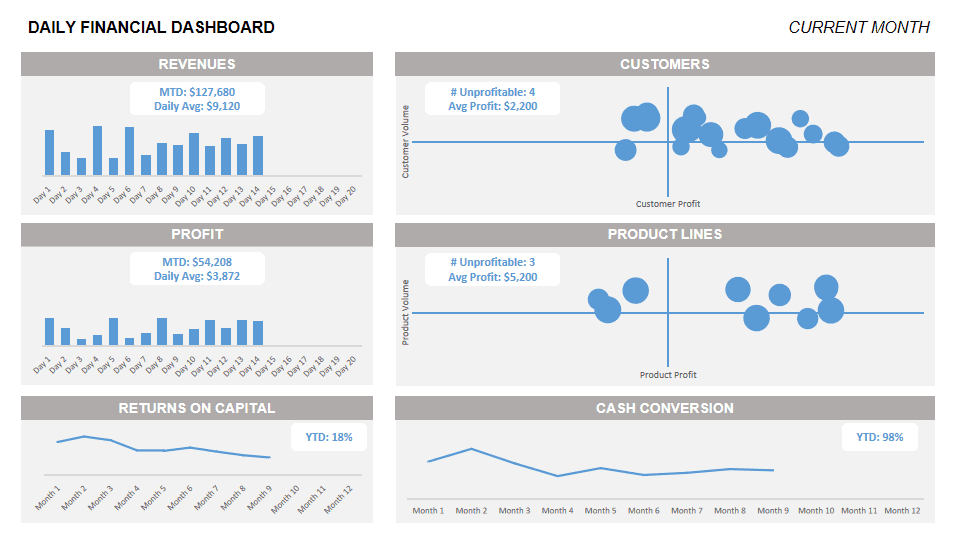
(Example of a typical dashboard for our business. Contact us to learn more.)
One of the first initiatives we take as an owner of businesses is to create a financial dashboard for the business team that can also be updated weekly with minimal effort. Imagine being able to open an app on your phone and know which customers, product and service is delivering profit and growth yesterday - that’s what are dashboards do.
Operational routines
Data without action is lost opportunity. We maximize opportunity by weaving dashboards and insights into operational routines. A routine is a repeated action that contributes to positive results. Our financial model supports routines. Our typical operational routine is a process of validating, communicating, actioning and closing out insights from dashboards. Each of the routine involves answering questions such as:
· Validating: Is the insight from the dashboard accurate?
· Communicating: Did the owner of the insight receive it and understand what to do about it?
· Action: Is the owner taking action to address the insight?
· Close out: Has the action been completed and did it met its objective?
A common example of an operational routine in action is identifying when a customer’s pricing is unprofitable and tasking sales persons to raise prices to improve profitability.
Each step in the operational routine is designed to ground financial insight into operational execution with defined owners, objectives, outcomes and accountability.
Linkages across The Norton Henry System
The financial model supports each leg of the Norton Henry System.
· The financial model supports action and accountability of each individual on the team (People).
· The financial model ensures each customer is satisfied and contributes to growth (Customer).
· The financial model ensures products and services are efficient, deliver returns and contribute to growth (Products).
· The financial model enables execution (Delivery).
· The financial model supports the behaviors and norms supporting short- and long-term goals (Culture).
We’re happy to share more about the learnings we’ve gained with our financial model, The Norton Henry System, and how it leads to successfully extending legacies of owner-operators.